Story
From the workbench of the future to the workbench of a joinery.
HARDWOOD is what happens when a piece of Silicon Valley industrial design meets a German joiner's shop — and neither one wins.
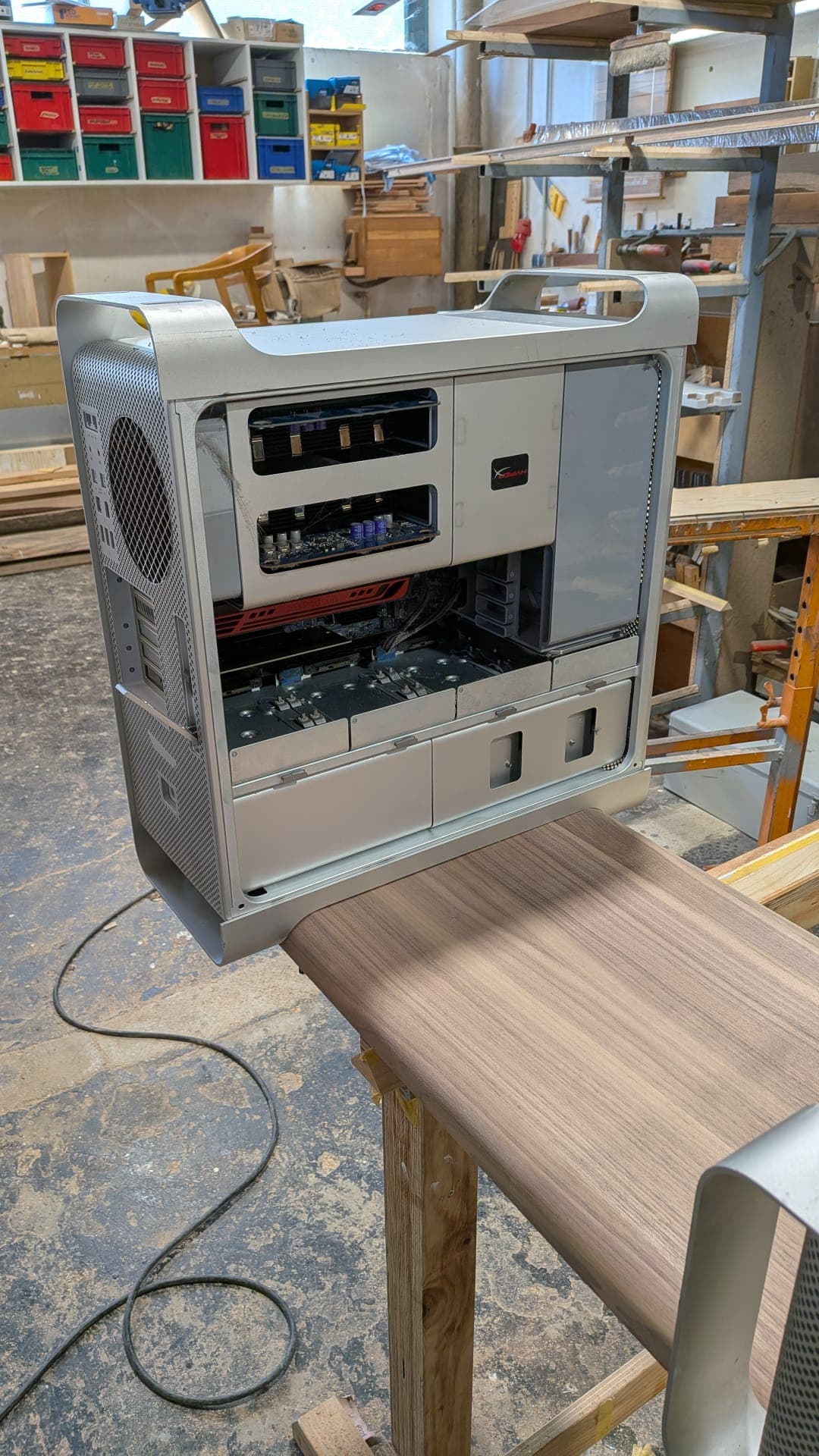
Hardware as heritage
For a generation of makers, the Mac Pro tower was the machine you aspired to. It sat under the desk of studios, edit suites and founder offices — a statement of intent as much as a tool. Its aluminium enclosure was designed by people who believed a computer should be beautiful inside and out, and repairable enough to keep for a decade.
Most of those machines have now outlived their usefulness as computers. The processors are slow, the ports are dated, the operating system has moved on. But the enclosure — the part you actually see and touch — is as good as the day it left the factory.
Silicon Valley meets the joinery
HARDWOOD started with a simple observation: the Mac Pro tower is already furniture-grade. It's precise, heavy, cool to the touch, and unmistakable. All it needs is a reason to stay in the room.
We give it that reason with wood. Working in a joinery in Germany, we pair two towers with a single solid plank of American walnut, hand-finished so the grain flows over the edges. The result is neither a computer nor a conventional bench. It's a third thing.
“A computer is designed to be replaced. Furniture is designed to be kept.”
Aluminium and American walnut
The contrast is the point. Anodized aluminium is exact, industrial and cold. American walnut is warm, organic and alive — it moves, it darkens, it records the years. Set against each other, each material makes the other more itself.
This is not an upcycling project and it is not a nostalgia object. It's a considered pairing of two of the best materials the last century produced, built to be used every day.
Why old machines become lasting objects
A computer is designed to be replaced. Furniture is designed to be kept. By moving the enclosure from one category to the other, we extend its life by decades and keep a well-made object out of the recycling stream.
The first HARDWOOD Bench was built by hand as a single piece. The version you can join the waitlist for is the refinement of that first bench — same idea, made repeatable.